Taylor Simmons · 22 September 2026
Examining Boundary Layer Dynamics in Complex Polyhedral Systems for Industrial Applications
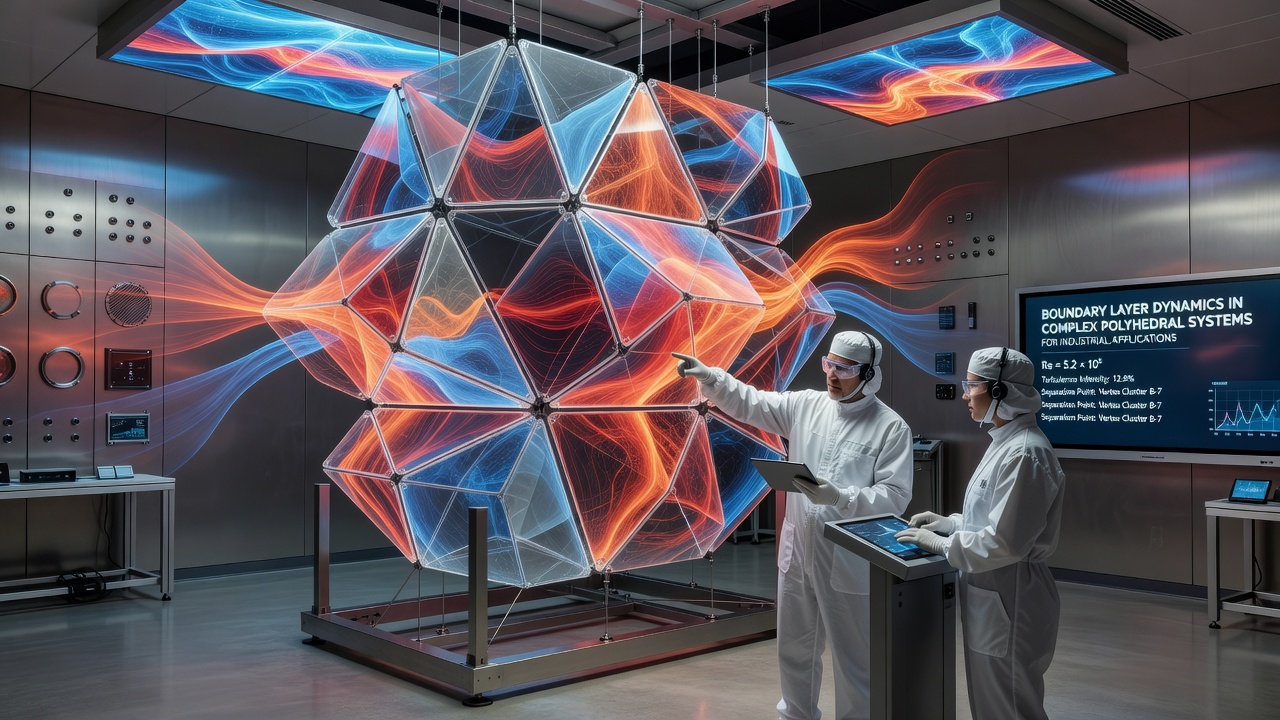
Boundary layer dynamics describe the thin layer of fluid near a surface where velocity transitions from zero at the wall to the free-stream value, and researchers examine these patterns closely when surfaces take on polyhedral forms with multiple flat faces and sharp edges. Engineers study how flow separates, reattaches, and creates vortices around such geometries because polyhedral shapes appear in turbine blades, vehicle panels, and structural components across manufacturing and energy sectors. Data from wind tunnel tests show that edge angles and face orientations alter pressure gradients, which in turn shift transition points from laminar to turbulent states within the boundary layer.
Core Principles of Boundary Layer Behavior
Prandtl introduced the boundary layer concept in 1904, and subsequent work has extended those equations to irregular surfaces where curvature changes abruptly at each facet junction. In polyhedral systems the flow encounters repeated pressure jumps at vertices and edges, so the momentum thickness grows unevenly along each face while skin friction coefficients vary by as much as thirty percent between adjacent panels according to computational fluid dynamics records. Observers note that separation bubbles often form downstream of leading edges on blunt polyhedra, yet reattachment lengths shorten when incoming turbulence intensity rises above five percent.
Polyhedral Geometries in Practice
Industrial designers incorporate polyhedral elements into heat exchanger fins, drone airframes, and mixing vessels because these forms balance structural stiffness against weight while influencing flow resistance. A study released by the National Aeronautics and Space Administration in 2024 documented how a twelve-faced polyhedral fairing reduced drag by fourteen percent compared with a smooth equivalent at Mach 0.3, although the same shape increased noise levels in the near wake. Those measurements came from scaled models tested at the Langley Research Center, where particle image velocimetry captured the three-dimensional boundary layer structures wrapping around each facet.
Measurement Techniques and Modeling Approaches
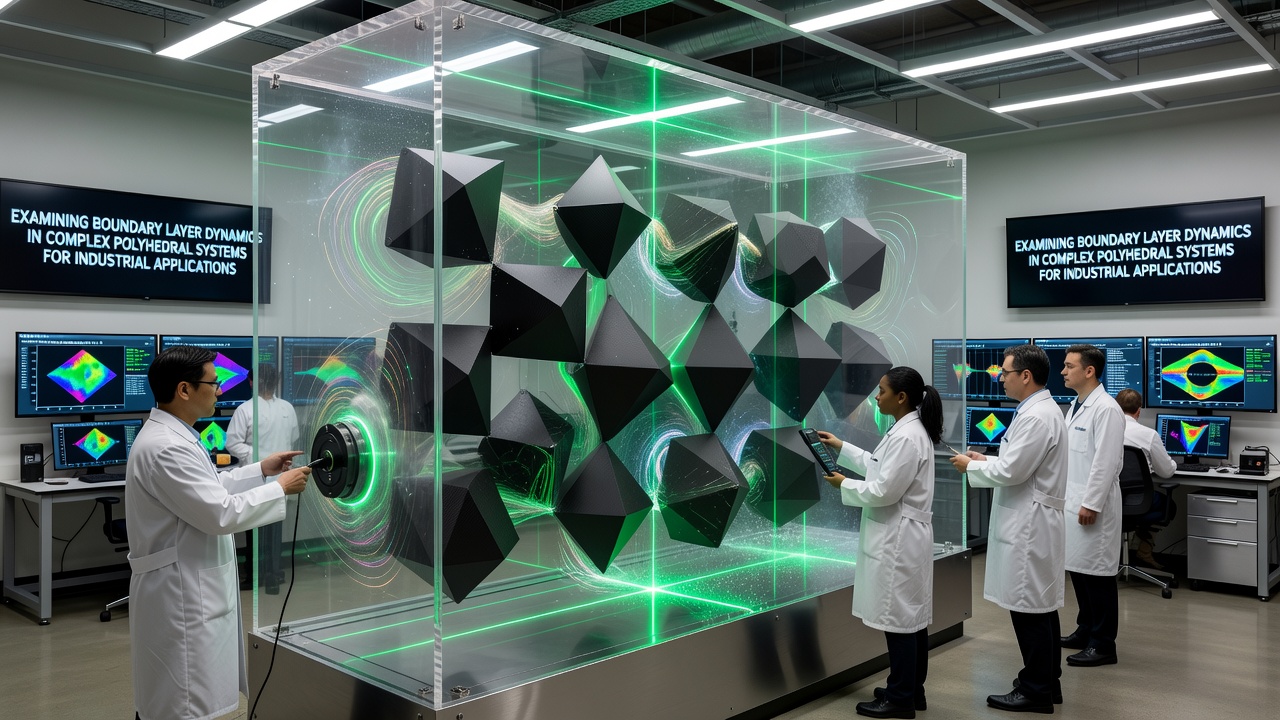
Hot-wire anemometry and laser Doppler velocimetry remain standard tools for capturing velocity profiles, yet high-resolution large-eddy simulations now supplement physical experiments by resolving the smallest scales near sharp corners. Researchers at the Technical University of Denmark reported in 2025 that hybrid Reynolds-averaged Navier-Stokes and large-eddy models predict transition locations on polyhedral surfaces within eight percent of experimental values when mesh refinement reaches y-plus values below one. These numerical approaches also reveal how secondary flows along facet intersections transport high-momentum fluid toward the surface, delaying separation on downstream faces.
September 2026 will see the European Research Council host a dedicated workshop on polyhedral boundary layer control in Delft, where teams from multiple countries plan to share updated datasets on active flow control using synthetic jets placed at vertices. Preliminary abstracts indicate that pulsed actuation at frequencies matching the natural vortex shedding reduces form drag by up to eleven percent on representative industrial shapes.
Applications Across Sectors
In aerospace manufacturing, polyhedral wing tips and control surfaces undergo repeated boundary layer scrutiny because small changes in facet angle can shift the buffet boundary during high-speed flight. Automotive engineers apply similar analysis to mirror housings and underbody diffusers that feature faceted geometries for packaging reasons, and wind-tunnel results from the Australian Automotive Research Centre show that optimized edge radii cut total vehicle drag by four to six percent. Power generation equipment benefits as well; gas turbine stator vanes with polyhedral cooling channel inserts demonstrate improved film-cooling effectiveness when boundary layer ingestion at each facet is accounted for in the design cycle.
Process industries rely on polyhedral agitators inside chemical reactors, where boundary layer detachment controls mixing rates and heat transfer coefficients. Laboratory measurements at the University of Alberta indicate that increasing the number of faces from eight to twenty raises the Sherwood number by twenty-two percent under otherwise identical Reynolds numbers, although pressure drop rises correspondingly. These trade-offs guide selection of impeller geometry during scale-up from pilot to production vessels.
Challenges and Ongoing Developments
Sharp corners on polyhedral bodies generate strong streamwise vortices that interact with the boundary layer on neighboring faces, creating complex three-dimensional topologies that resist simple analytical description. Surface roughness introduced during additive manufacturing further modulates transition, and studies coordinated by the Canadian National Research Council have quantified how as-built roughness elements shift transition Reynolds numbers by fifteen to twenty-five percent compared with polished counterparts. Mitigation strategies include rounding selected edges, applying riblets aligned with local flow, and integrating passive vortex generators at facet junctions to energize the near-wall flow.
Conclusion
Boundary layer dynamics in complex polyhedral systems continue to influence performance metrics across aerospace, automotive, energy, and chemical processing fields, and ongoing measurement campaigns together with refined numerical methods supply the data needed for geometry optimization. Events scheduled for September 2026 will consolidate findings from several continents, while links to open datasets hosted by NASA and the European Research Council allow broader access to validated cases. Continued integration of these insights supports incremental gains in efficiency and reliability for equipment that must operate reliably under varying flow conditions.