Greta Krause · 8 September 2026
How Polytope Calculations Optimize Resource Allocation in Complex Systems
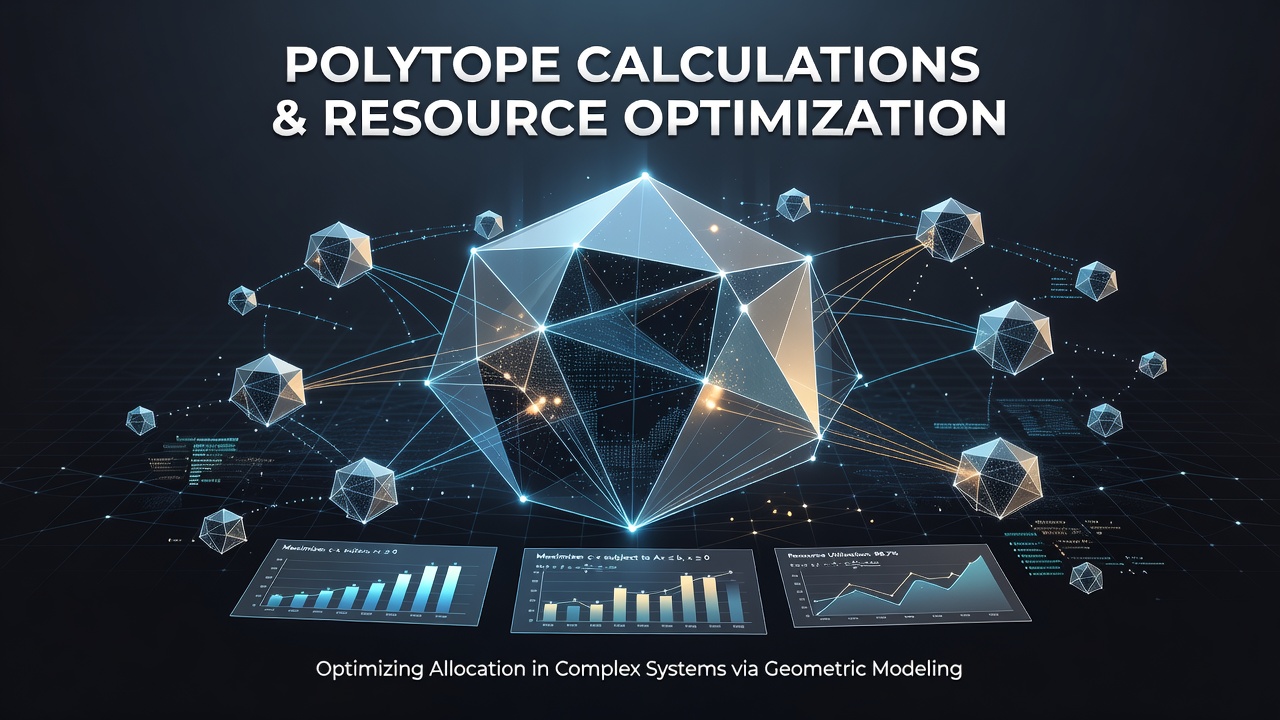
Polytope calculations provide a mathematical framework for modeling feasible regions in high-dimensional spaces, where each dimension corresponds to a decision variable in resource allocation problems, and the boundaries represent constraints such as capacity limits, budget caps, and regulatory requirements. Researchers have applied these geometric structures since the mid-twentieth century to solve linear programming tasks that allocate limited resources across competing demands in networks, supply chains, and production facilities. Data from operations research indicates that polytope-based methods reduce computational time for large-scale problems compared with exhaustive enumeration approaches because the feasible set remains convex and algorithms like the simplex method traverse only the vertices.
Defining Polytopes in Optimization Contexts
A polytope emerges as the convex hull of a finite set of points in Euclidean space, which means every point inside satisfies a system of linear inequalities that define the resource boundaries. In complex systems, these inequalities encode physical limits such as maximum throughput on transport links or minimum staffing levels in service operations, while the objective function seeks to maximize output or minimize cost. Observers note that the number of vertices grows exponentially with dimension, yet specialized solvers exploit sparsity adn symmetry to locate optimal vertices without enumerating every corner. According to studies published by the European Commission Joint Research Centre, polytope representations have supported decision models for energy distribution grids where thousands of variables interact under seasonal demand fluctuations.
Application in Supply Chain and Logistics Networks
Logistics planners employ polytope calculations to determine shipment volumes across multi-echelon networks while respecting warehouse capacities, vehicle routes, and delivery windows. One documented case involved a North American freight operator that reformulated its allocation model as a polytope intersection problem, then used interior-point methods to achieve feasible schedules within seconds rather than hours. Figures released by Transport Canada in 2025 showed measurable decreases in empty backhauls after such models were integrated into daily planning software. The same geometric approach extends to inventory positioning, where safety stock levels form additional facets of the polytope and the solver identifies allocations that buffer against demand variability without excess capital tie-up.
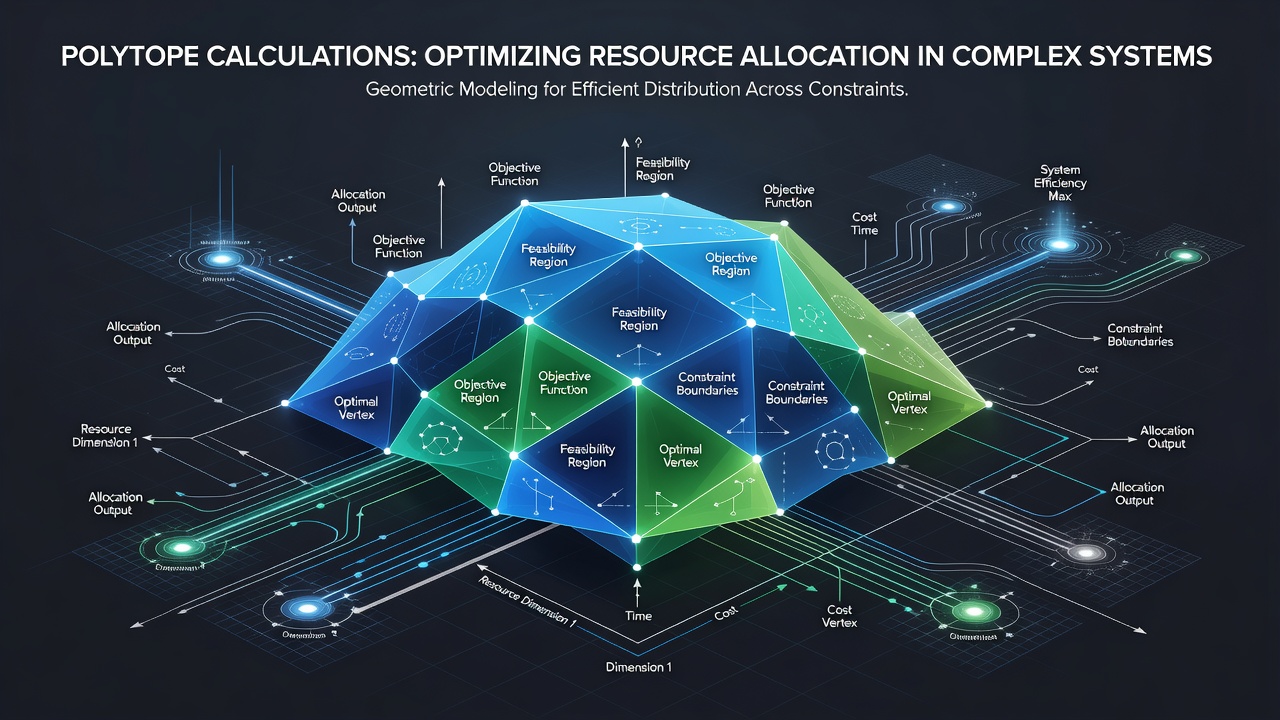
What's interesting is how these calculations scale when uncertainty enters the picture. Stochastic programming augments the polytope with scenario-based constraints, creating a larger but still convex structure that hedges against multiple future states. Research teams at the University of Melbourne have tested such extensions on Australian port operations, where container handling resources must accommodate variable vessel arrival patterns. Their results, presented at an international conference scheduled for September 2026, demonstrate that polytope projections can isolate robust allocation decisions that remain effective across a range of demand realizations.
Integration with Modern Computing Architectures
High-performance computing clusters now accelerate polytope vertex enumeration through parallel branch-and-bound procedures, allowing real-time re-optimization when system parameters shift. Government agencies in Singapore have incorporated these techniques into water distribution models that balance reservoir releases, pipeline pressures, and treatment plant capacities under drought contingencies. The underlying software relies on libraries that represent polytopes via half-space descriptions or vertex lists, switching representations dynamically to exploit whichever format yields faster pivot operations. Industry reports from the IEEE indicate that GPU-accelerated linear programming solvers have cut solution times by factors of ten for problems exceeding ten thousand constraints, making previously intractable allocation tasks routine in manufacturing and telecommunications sectors.
Challenges and Ongoing Refinements
Despite efficiency gains, high-dimensional polytopes can still overwhelm memory when the number of facets exceeds available storage, prompting ongoing work on decomposition methods that break large problems into coordinated sub-polytopes. Canadian researchers affiliated with the National Research Council have explored column-generation techniques that add only the most relevant constraints during iteration, thereby keeping the active polytope manageable. Their approach has been validated on forestry harvest scheduling models where spatial adjacency rules create dense constraint matrices. Meanwhile, machine-learning hybrids that predict promising vertex neighborhoods are under evaluation at several academic centers, with preliminary benchmarks suggesting further reductions in iteration counts.
Conclusion
Polytope calculations continue to underpin resource allocation decisions across diverse complex systems by converting constraint sets into searchable geometric objects whose optimal points correspond to efficient distributions. Evidence accumulated from transport authorities, energy regulators, and academic consortia shows consistent performance advantages when these methods replace heuristic or simulation-only strategies. As computing hardware advances and hybrid algorithms mature, the scope of problems amenable to exact polytope optimization is expected to widen, supporting more precise management of scarce resources in interconnected environments.